Tuesday, November 24, 2009

Did my nickname have to be Riverboy?

My first time on the river, how it changed my life & I why I still begrudge Tom Meckfessel.

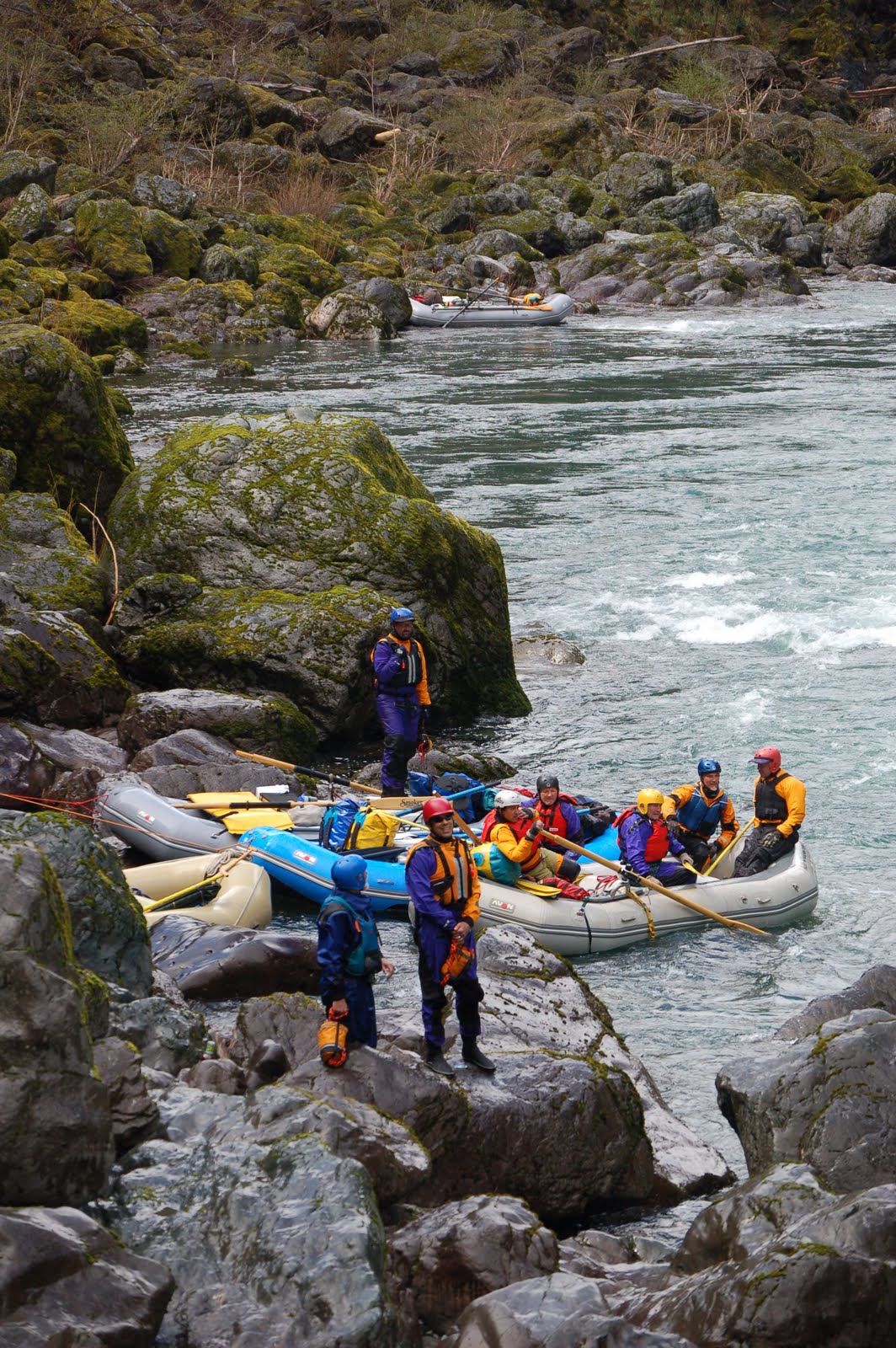
When I got out of the Navy in '92, and with no prior experience, I decided I wanted to be three things: mountaineer, big wall climber & whitewater kayaker. I didn't know any mountaineers or big wall climbers but my sister's boyfriend Tom was a river guide. Taking pity on her little brother, my sister invited me (against Tom's better judgement) on their upcoming float down the lower main Salmon. So I made my way up I-84 from the thriving metropolis of Troutdale, Oregon to the burg of Whitebird, Idaho where I met up with up with Tom, Elizabeth and their friends Danny and Viv. Addie, the best dog ever, and her deaf daughter Mae were their as well.

There were a total of three boats on the trip: an Avon Adventurer, Tom's drift boat and the state of the art kayak for the day, a Dancer XT. Unlike today's whitewater kayaks which are all flat on the bottom and excedingly stable, the kayaks of the 70s, 80s and early 90s were all designed based on the cigar, and had all the stabilty of a beach ball. When we put on the river at Hammer Creek I had never actually been in a kayak before. I did, however own a copy of William Nealy's Kayak, which I really thought would give me a solid leg up in lieu of experience. After all, I had looked over his cartoon instructions on how to roll a kayak on more than one occasion. You just stick the paddle out to the side and kind of pull back on it and then the kayak rights itself and you move on with your life. How hard could it be?

Tom has never been a big advocate of hanging around at the put-in. So rather than waste time with actual "hands on" instruction, he offered me some quality tidbits of paddle advice instead: point the kayak into waves and holes, keep the paddle in the water, and lean downstream. Between Tom Meckfessel's 30 Second Whitewater School and William Nealy's cartoon instruction book, the casual reader will no doubt be lead to believe that I instantly mastered the way of the kayak and went on to win the silver in the olympics later that summer. Based soley on the first rapid we encountered, anyone watching from the shore, would have assumed that I had been kayaking for years and that I was as well versed at playing in the water as any river otter.

That first rapid is called Rollercoaster. It's a long class II of big, fun, easy, rolling waves. Tom had given me three small tasks which he assured me would keep my head above water (As easy as explaining to one of the Matis tribespeople of the Amazon, who had never even sat in a car, the mechanics of driving said car in three simple steps: let out the clutch, give it some gas, point the wheels in the direction you want to go. Got it? Okay, welcome to Seattle. Have fun driving around the city). And just like the poor Matis indian who sideswipes a dozen cars before bring his vehicle to a gentle stop on the steps of the public library, I too was doomed to failure.

After the first couple of rollers, I turned the boat sideways to the waves, took the paddle out of the water and leaned upstream. If you're wondering what the fastest way to turn a kayak upside down is, I would highly recommend this method. It may not be the absolute fastest method but it'll guarantee results. I sat there underwater for a moment, bobbing down the river, the hand drawn instructions for rolling a boat playing through my head. I leaned forward. I pulled the paddle. And voila!, I was back on top of the water, paddling my way successfully through the remainder of the rapid.

Tom, Dan, Viv and my sister all cheered. Even the dogs looked impressed. I had never been in a kayak before in my life and within 90 seconds of getting on the water I had successfully completed my first combat roll. But, just like the perfect joke that escapes your lips accidentally that people might remember you for but never again receives a laugh no matter who you try to tell it to in the future, my history of rolling a kayak - upright at least - had come to an end. I swam 72 miles of Salmon and Snake rivers over the next five days.

Back in 1992 I was 21 years old, 50lbs lighter and had an unbelievable amount of energy. And that was good, because a person expends quite a bit of energy tipping a kayak over, trying to roll the kayak upright three or four times, wet exiting, pulling the kayak to the shore, dumping out all the water, putting the skirt back on and paddling back into the current - every 50 feet or so for 12 to 15 miles a day.

I don't remember where our first camp was - I actually don't remember where any of our camps were - but I do remember I still had some energy left over. Enough that that the rest of the group was looking for way to get rid of me so that they could have a little quiet time on the river. With the exception of my sister, no one else had any idea just how much I could talk, and the truth of the matter is, I could talk a lot. So when we got to camp that first day, and nobody could get me to shut up, Tom and Dan devised the Salmon River Challenge: a peak above all others, inaccessible to all but the most confident of the mountain goats, give me a time limit of an hour or two, and tell me they didn't think it could be done. And with that, they'd have their relaxing drinks on the river while playing cribbage and making dinner. After the sun set they would turn on their head lamps so I might have a better chance of making it back to camp (they knew my sister would make a fuss if I didn't make it back). And then I'd come limping back onto the beach. Bleeding. Bruised. Covered in poison oak. Ready for a beer.

And for all my effort, for all the swimming and the paddling and the near drowning and the forays into the wilderness while the others enjoyed their gin & tonics on the beach, for all that they gave me a nickname: Riverboy.

And for that, I will never forgive them.

Tuesday, October 27, 2009

How to make class V a little hairier

I had an opportunity this summer to work on the Kern – not as a guide though – but as some sort of “manager”, thus ensuring that I would never get on the water. The Kern is broken into three sections: the Lower is below Lake Isabella, the Upper is above, and the Forks is pretty much the “Upper-Upper”.

Chris and Chandra pop out of the hole in Big Bean:

For day-trippers, the Kern is perfect because there are lots of access points and different runs, with everything from flat water to class V. The Forks is the only trip with difficult access and, for rafts, requires packing in with mules about two miles. It has great whitewater, is in a wilderness area (the Golden Trout), and is often considered one of the crown jewels of wilderness class V. As an outfitter, we don’t run very many trips on the Forks – it doesn’t fit well with the L.A. crowd scene.

At the end of April we decided to run a private Forks training trip. The date was set for May 12th. The cost of getting equipment (we use Avon Expeditions and Avon Adventures for our oar boats) down to the river is expensive so I wasn’t expecting my own boat. The numbers continued to go up though and at some point we discovered that, yes, we would need another oar boat and, yes, I would be taking it.

That was great news – for me (at the time), the only thing scarier than running big water was being someone’s passenger. Then, it turned out that my girlfriend wanted to go. Then, it turned out that my mother wanted to go. So I was left wondering exactly what the hell I had gotten myself into. They would be my paddle-assist and I now realized that the only thing scarier than being someone’s passenger is rowing your mother down class V.

Seven years ago my younger brother Matt and I ditched three days of high school, caught an Amtrak train to Bakersfield and a ride to Kernville to paddle-assist on the Forks. Looking back on the two days we had spent on the water all I could remember was a mango-salsa we had made at camp (must have been good) and Carson Falls, the very last rapid on the Forks. Not helpful.

Back to the present: After a day of packing-in (our Clavey oars and personal dry bags have to be hiked in), a night of sleep on the island (where the Little Kern meets the Kern, hence the “Forks”), and a jittery breakfast we pushed off and thus began the most nervous three days of boating I’ve ever had.

Ceremonial drinking of the Little Kern water:

The Forks is something incredibly special. When you’re not focused on the whitewater (rarely) you have a chance to catch a glimpse of a very dramatic and beautiful river canyon. The whitewater is, of course, one of the main draws to this section of river but it’s not what I would call “stupid-big”. The thing that is most impressive about the whitewater is how continuous it is.

A side-hike up Peppermint Creek led to this impressive waterfall:

From a statistics book, one probably wouldn’t predict the Forks to be as great as it is. The gradient is only 65 feet per mile and the run is only 18 miles. There are lots of rivers and creeks that match up and exceed both of these numbers. This is a great thing about rivers and creeks – they aren’t machines, you can’t just look at numbers, they’re dynamic and sometimes you just have to be there to see what they’re like. We like to look at rapids and say “this one’s class III, this one over here is class IV-, and so on…” and I could do that for every rapid I’ve seen, but what I would prefer and what is more meaningful to me is to just say that it is “big” water and - when your mother is in the boat - it is “bigger” water.

Continuous whitewater on the Forks of the Kern:

I have never boated the same river twice- unless you look at it geographically or by name- and I’m certain I will never boat the Forks the same way I did back in May – with my mother and girlfriend in the front sharing and living through the same whitewater and river canyon that I was. Sharing the moment when we watched, as the number two boat, the lead boat get surfed wildly at Vortex (one of the “big ones”) and lose the two bow paddlers just above The Gauntlet (another “big one”) and me screaming at them to get down and huddle in the front rather than paddle (I was terrified of accidentally knocking one of them out of the boat and was fairly certain I could keep the boat upright).

The peak of the trip for me was reaching the lead-in to Carson Falls, pulling over, and walking down the scout trail. The drop led into a huge lateral hole, which, if you hit it correctly, you would punch. Otherwise, you would end up going into “The Thing” – a large nasty pour-over covering the right side of the river. I picked out a marker and knew we could hit it. We did, but we did not have enough left-angle and the monster hole zipped us straight to the lip of The Thing.

Will, Dana, and Mary dropping into the hole in Big Bean:

A friend had hiked up from the road to take photos of the boats dropping Carson. He snapped a photo of our boat on the brink of The Thing. There is a look of horror on my face as I try to straighten the boat out, Dana looks shocked that we ended up where we did, and my mom… she’s giggling. I guess she knew we would end up just fine.

About to drop into The Thing:

Wednesday, September 9, 2009

Scotto's Bachelor Party on the T

You can say what you want about the sanctity of marriage. You can say 50% of marriages end in divorce. You can say it’s an antiquated institution that’s no longer necessary in modern society. And to you I say this: If marriage is nothing more than an excuse to get all your best buds together to float some of the best whitewater in the world while pushing your liver to its limit, then I say it’s worth it (No honey, of course that’s not why we’re getting married).

We were loading boats and gear when those friends of mine who’re either irresponsible enough to take off work for a Thursday and Friday or unemployed enough not to have to, started showing up at Clavey HQ. There would be ten of us all together - Jeff and Tom of course; John Finger of Hog Island who can never say no to the possibility of not catching any fish; Frank Wheeler (the token Republican); our good buddy Tony Negro who would, in good buddy fashion, dutifully accept anything negative which might happen on the trip (ticket from the CHP, broken finger); my brother-in-law and public defender Mark Briscoe (he’d come in handy for sure); a couple of my barely employed buddies from LA, Crawford and Hansenmum; Michael Ingram, my physical doppleganger; and joining us on the second day of the trip would be Scott Armstrong of All Outdoors, who would row in with more beer and ice.

The Tuolumne is one of those funny rivers that isn’t really all that far away but always seems like it’s in another time zone whenever we start talking about a trip. A paltry four hours after shutting the doors at Clavey* we were rolling into Casa Loma. (*One of the fun things about closing the doors at Clavey for a long weekend is coming back to the complaints from the people who claim we’re never open when they come by. We’re open six days a week, all year long, with the exception of one to two river trips where we’ll close down on Friday and Saturday. This trip was no exception and we came back to the shop on Monday to a voicemail from a guy claiming he had driven to the shop from Wisconsin looking for an A-7 valve. You’d think it would be easier to have us ship it to him but some guys are looking for any excuse to get out of the house - “Honey, I’m gonna drive over to California for a five dollar part for the raft. Do you need anything?”

Tom had offered to make dinner for the All Outdoors Cherry Creek crew at the guide shack that night. Somehow Tom’s dinner became John’s dinner and we started our trip with Finger making an insane clam and spanish chorizo pasta and about four thousand raw oysters. We re-covered their gravel driveway with so many bivalve shells that future archeologists in the next millennium will come to the conclusion that Casa Loma was at one time covered by the Pacific Ocean. If I remember correctly, there may have been a beer in there somewhere also. If only I could remember correctly.

The take-out for Cherry Creek is the put-in for the Wild & Scenic run of the T. So Friday morning, Tony took off with the AO crew to run Cherry Creek while the rest of us took off for Meral’s Pool to rig the boats. The water on the Tuolumne is released from Hetch Hetchy and takes a few hours to fill the first rapid with enough water to make it almost runnable. So by the time the water began to rise, we knew the Cherry Creek crew wouldn’t be far behind. Tony’s a guy who’s run all the big runs in the Western US, but his brother’s drowning on Cherry Creek ten years previously had kept him from getting on the run himself. The first thing we saw on Tony’s boat as he rowed into Meral’s Pool that first morning was the huge shit eating grin on his face. With the exception of crushing the tip of his finger between the frame and the oar on the final rapid, they couldn’t have had a better trip.

I love the Tuolumne River. I love the camps. I love the whitewater. I love the hikes. But something I don’t love is the very first rapid, Rock Garden. I can’t think of better way to start a three day trip on a solid class IV river than to get stuck on the very first rapid. That must be why I do it every single freakin’ time. And this time was no exception. I was running a stern rig on an Avon Expedition with Briscoe, Ingram, Crawford and Hansenmum up front. Normally, a set up like this is perfect for the T - plenty of control from the oars and lots of power from the paddlers - but not me, not at Rock Garden. If you know the T, you know you come in right, hit this eddy that doesn’t exist in the center of the river after negotiating your way through a minefield of rocks, most of which are just below the surface and then run the left side which is totally choked with boulders but feels like the middle of the Pacific Ocean after making your way through the right side. In a perfect world, the first boater will hit the eddy, hop on the big rock and catch the stern line of the following boat and pendulum them into the eddy. That’s not the world I row my boat in.

Jeff, the old ex-T guide that he is, missed all the rocks and then slipped his boat perfectly into the eddy, hopped onto the big rock and waited for my stern line to be thrown his way. He’d be waiting for a while. About fifteen feet into a quarter mile rapid, I crabbed an oar, spun the boat 180º from where I needed to be and lost Crawford to a rock on the middle river. As luck was with me, it was then that I completely lost my downstream oar and bounced right past the eddy I so desperately wanted to be sitting in. About this time, two words came to mind and the first one rhymed with truck. One good thing about Rock Garden at this level, you don’t have to worry about going too far the wrong way - you’re bound to get caught on something and we were no exception. Its funny how you spend years on the river trying to stay away from the rocks and the one time you want to be actually stuck on a rock so you can take a breath, survey the situation, maybe put your oar back in the oarlock, someone will begin bouncing up and down like a five year old on an inflatable jumpie, trying to get the boat dislodged. “Hey! Stop that!” The offended paddler looked back at me momentarily and then began bouncing up and down again. What is it about men that even the laziest of us will gladly chip in to help when our help is desperately unwanted. I explained myself a little more clearly the second time, put my oar where it might be a touch more useful and threw a line to Jeff who was clearly excited to be starting the trip in such an auspicious manner. We got my boat in the eddy, gave Crawford a quick lesson in ,“How to hold on to a throw rope while being pulled across a raging river”. He heard about every third word I said but figured the gist of the conversation was, “Don’t let go”. And then we got back in the boat for the remaining 95% of the rapid.

Remember when I described the left side of Rock Garden as the Pacific Ocean? That being the case, I first hit Hawaii and then careened off Tahiti, the Marquesas and seven other lesser known Society Islands before finally jamming the boat between Australia and New Zealand. Thirty minutes later all said and done and we were finally through the first rapid. At this rate it would take us just under a month to get to camp. And of course if they turn on the water at Hetch Hetchy it means they at some point are going to turn off the water as well.

Rock Garden made me take a hard look at my rowing, my paddlers, my boat, the weight in my boat. I decided we couldn’t go into Nemesis with all the weight we currently had in the boat and made the crew lighten our load by exactly five cans of beer. The overburden of beer had clearly been the issue because we were now at the top of our game, punching holes, surfing waves avoiding all but the most inviting of rocks.

I’m one of those guys that, no matter how many times I run a river, I can remember a grand total of maybe three rapids. On the Tuolumne I remember Rock Garden, I remember Clavey and I spend the rest of the time shouting over to Tom or Jeff, “What’s the story here?” I don’t bother asking the name. I’m happy if I can remember, “Go left, move right, avoid the big hole in the center”. All I can tell you about anything between the debacle at the first rapid and Clavey is that we must have gone left, moved right and avoided the big hole in the center. In the midst of Ram’s Head, Tony and Frank were getting awfully warm so Tom was nice enough to oblige them with a swim. I would have waited for the pool at the bottom of the rapid, but I’m not as adventurous as some. At Clavey we took a brief scout and hit it perfect. Or so I was told. When we hit the hole, I came flying off the slant board and spent the remainder of the rapid trying to get up off the floor. And those are the three rapids I can remember.

We pulled into camp at Indian Creek and began running our livers through the gauntlet. The key to drinking and not getting fall-over, sloppy, drunk, is to involve yourself in some form of rigorous challenging exercise intensive sport followed by a light meal. We played bocci ball and ate 2 lb ribeyes. The bocci ball was intense. For my bachelor party I had surrounded myself with whitewater warrior athletes and I couldn’t remember a time when the competition had been more fierce. Of course, I couldn’t remember the last rapid we had run before getting to camp either. But I could sure remember those steaks. They were pretty good like Michael Jordan was a pretty good basketball player.

The next two days were more of the same. Fantastic food. Cold beer. Awesome rapids. And great friends. Scott Armstrong rowed in that second morning with more provisions in his cooler, sitting on the floor of his boat...not even strapped down. It wasn’t like it was jammed between the thwarts either. His boat had two thwarts - one under his seat and one in the center to brace his feet on on. The cooler was just sitting there in front of the center thwart, just sitting there. Believe me when I tell you a cooler sitting on a flaccid boat floor is not a stable platform to jump on from one boat to another. And let me tell you something else: if you ever have an injured person on your trip and you don’t want them to ruin everybody else’s good time, you want Tony Negro to be that injured somebody. He’s the most stoic bastard you ever seen. The Monday after getting off the river, he went to get his hand x-rayed. The single tip of his finger had become multiple tips of the same finger. God help the group if I get a hangnail. You will not hear the end of how much I’m suffering. But not Tony. Showoff.

Mr. Armstrong, Mr. Kellogg, Mr. Meckfessel, Mr. Negro, Mr, Wheeler, Mr. Ingram, Mr. Finger, Mr. Briscoe, Mr. Crawford & Mr. Hansenmum, thank you gentlemen so very much for an unforgettable bachelor party. My only question is, we own a freaking rafting equipment company, why do I always have to get married for us to shut the doors and get on the water?

Tuesday, August 25, 2009

The Milky Way in Tomales Bay

More stars in the water then there were in the sky.

Nicole and I pulled into the parking lot at Nick's Cove right on the money at 6:30 for our bioluminescence kayak tour on Tomales Bay. There was Jeff unloading kayaks from the Clavey trailer and most of our guests were in small groups chatting it up about the upcoming light show. We left Sebastopol at 85º and sunny a half hour earlier and now we were getting out of the car under the cold low clouds of Tomales Bay. We thought perhaps these weren't the best conditions but Scott Terriberry, our guide, was giddy with excitement. "No stars, no ambient light," he said, with the animation of a schoolboy waiting for his favorite NBA star to stop by the house, "makes for absolutely perfect conditions. We simply couldn't ask for more." His enthusiasm was contagious. We pulled on our gear, grabbed our kayaks and made our way to the rest of our group - one of the many heading out that night.

People have been asking us for years, " Do you do tours? Do you offer classes? Can you teach me how to roll?" And for years the answer was always the same - "No. No. No." But then the stars aligned and a couple of guides and instructors we'd always admired got freed up from their prior commitments and before you could say, "Yes. Yes. Yes.", we had ourselves an outfitter's permit, some insurance and a heck of a lot of sign ups. And so here we were on a moonless, cloudy night on Tomales Bay waiting for the sun to finally set so the show could begin.

Scott likes to begin any evening paddle in the light of day. This way everyone can actually see where it is they're going and get a feel for what the area looks like before nature turns out the lights. Sure we've all got headlamps, and they're top notch headlamps too, but they don't really replace the light of day. So with the sun still up there behind the clouds, Scott gets us all together for a little talk about safety, what to expect, how to stay together, etc. He traces our route across the bay with his finger, pointing out the oyster beds, the beaches, the gulch, the island. And with that all said and done, we carry our boats down to the water and away we go.

Once on the bay, Terriberry assigns everybody a number (I'm 15). So when the lights go down, we can all check in easily - all present and accounted for. The momma duck would hate to lose her babies. And with that the tour begins in earnest. Time: 7:30ish

In this group of 17 people the stats break down as such: 3 trained guides, 2 canoeist (in 1 canoe), 5 intermediate kayakers, 3 whitewater boaters and 4 beginners. 10 people (including canoeists) had their own boat. All 17 people were stable, comfortable and confident once we got on the water.

We leisurely paddled through the eel grass, over to the oyster beds and across to an officially unnamed beach unofficially named Pine Flat. By now the sun had set and the darkness quickly enveloped us. We counted off (15!) and Scott showed us how we could see the bioluminescence even in the beach as we dragged our feet back and forth in the wet sand. Cool! Time enough to squeeze the bladder dry and then back into the kayaks.

The water around my paddle blade explodes with light as I dip it into the bay. Awesome! I take another paddle stroke and thousands (maybe millions) of tiny one celled creatures light up in protest (or in frivolity for all I know) around each dip of the blade. I look over at Nicole's boat. The hull glows as it scoots through water. Motivated for light, I pick up the pace of my paddle strokes, pushing the kayak as fast as my little arms can make it go. My boat lights up like I'm in some sort of low tech Christmas parade. It reminds me of my childhood: dragging my pug, Chowder, across the carpet of the living room on one of those remarkably cold, dry, winter nights. The poor dog lit up like Chernobyl as static electricity from his fur and the carpet brought the darkened room back into the light. But this paddle on Tomales Bay was way better. First off, no pugs we're terrified in the glowing of light. And second, we were about to paddle into White Gulch and the the bioluminescence was about to go off the charts. Or as they say in Spinal Tap, "It goes to 11."

As we've all been totally riveted to the lightshow, Scott wants to make sure no one wandered off so we do another headcount (15!) before heading into the shallow mossy, fish filled water of White Gulch. All present. And now for the headline act. The bioluminescence explodes around the fish as they dart from our boats. Terriberry yells out as one of the little bastards jumps onto his lap. The silence of the evening is broken with cries of, "Look at this! Right here! Look at that. Oh my god!"

Originally, I had wanted to describe our experience with the bioluminescence as fireworks in the water. But the bioluminescence of the greater bay was but mere sparklers to the New Years Eve at Times Square that was the waters of White Gulch. Terriberry herded us into a little area he knew was thick with moss. Plunge your hand into the water and pull it out with great gob of moss and it drips bioluminescence like radioactive diamonds back down your arm and into the waters from whence it came. I pick up a glowing mass of moss and throw it at Nicole - I mean, if you're going on 40 years old and as excited as you were when you were 8 and walking into Disneyland for the first time, why not act like it?

The oohs and ahhs finally fade to the suggestion that we might paddle back to Nick's Cove and get a drink (I think it was me), and we all make the slow turn back to towards the cormorants of Hog Island and finally back to the dock. We load the kayaks and gear back onto the trailer while the rest of our paddlers huddle back into small chattering groups of excitement.

The feeling from everyone is identical: This was a tour impossible to describe properly and improbable that you might ever go on one better. A bioluminescence kayak tour on Tomales Bay is like the first time you meet a big celebrity - something you'll never forget and will tell everyone about for the rest of your life.


Monday, July 13, 2009

Tales of the Janitor or Confessions from the Stand Up Paddleboard

Posted by Tom Meckfessel


I arrive at one of my local surf breaks (one that I usually avoid because of the crowds -but it’s the perfect spot to SUP) at about a quarter to six in the morning. The drive from Point Reyes to Bolinas at this time of day can be as spectacular as my time on the water; the Olema Valley is covered with wisps of ground fog and I have to break for the occasional coyote. If I hadn’t checked my Mac for the surf report before I left the house, I would still know the surf was going to be smallish at best by how easily I find a place to park near the beach. And sure enough, the surf is small and there is nobody on the beach but me. These conditions are perfect for my paddleboard.

The beauty of Stand Up Paddling (or SUPing) is that it just doesn’t matter if there isn’t any surf because you can still go out, have some fun and get a good workout. I suit up and paddle out. The full moon is setting behind the Bolinas Mesa while the sun is rising over the Bolinas ridge and the early morning light is soft and yellow. I paddle out to the “patch”, a section of Duxbury reef known for its long gentle rollers. The view one gets from the stand up position is really quite unique. Because you are, in my case, six feet off the water and able to see approaching swells and sea life from a whole new angle. The water below me teams with life: harbor seals swimming about and fish swimming near the surface with the four ospreys checking them out from above. I catch a couple of small waves and am then buzzed by an enormous Stellar Sea Lion who swims right at me showing off a 3’ leopard shark that he has in his mouth. I feel a bit safer on the Stand Up – it nice not to have your legs dangling in the water for a change. I catch a few more nice long rollers and then decide to paddle over to the mouth of the lagoon just for the exercise. On the way, a pod of dolphins swims by. As far as different ways to start the day go, this rates pretty high.


Stand Up Paddle Boarding most likely got is start in the early days of Polynesia and is considered by many to be the original form of surfing. In the 1960’s the Waikiki beach boys used stand up boards to help manage surf classes, take photos of clients and gain a better view of incoming swells. In the past nine years Stand Up Paddling has had a resurgence with the help of surfing legends, Laird Hamilton and Gerry Lopez who are definitely pushing the limits of the sport - SUPing Teahapoo, SUPING the Grand Canyon. It’s also become popular in flat water conditions due to the fact that SUPing is an unbelievable core workout.

Surfing a SUP and paddling one in flat water involve a few similar skills (stance and paddle stroke) but differ greatly in board design and learning curve. I’ve surfed most of my life and can tell you that surfing a SUP is a little more difficult, a bit dangerous, involves quite a bit of practice and can humble the best of us. If you plan to venture out in the surf on a SUP make sure that you first have good wave knowledge and, most importantly, stay away from other people in the water until you have learned to control your board and kick out of a wave. Most beginning SUPs are around 12’ long and weigh 40lbs and in the hands of the inexperienced can be a formidable weapon.


SUPs that are designed for surfing are basically a long, wide, thick surfboards that range in length from 10’ – 12’6”. Because these boards are designed for the surf they have quite a bit of rocker so you are able to turn them once you catch a wave. While some of these boards work well in flat water they tend to push water in front of them (because of the rocker and upturned nose) and have a rather short water line (amount of board contacting the water) for their length. Flat water SUPs, like the Tahoe Rubicon, are designed with a displacement hull – like a kayak – and have much more board in the water. They are also flatter with little or no rocker. This all translates into a board that is more stable, tracks better and much faster in flat water conditions.


Paddles designed for the SUP are basically long canoe paddles that usually have a 20° bend at the throat of the paddle. This bend allows the paddle face to be perpendicular to the water when taking a stroke. The length of the paddle rages from 8” to 10” taller than the paddler depending on if you’re surfing or cruising. Here at Clavey our favorite paddle is the Sawyer QuickDraw Zephyr. Besides being beautiful, light and super strong, the Quick Draw adjusts from 63” to 90”, making it the only SUP paddle you’ll ever need.

The beauty of Stand Up Paddling is its simplicity. Board, paddle, water. That’s all you need. I’ve got more outdoor gear than the average REI store, so to me the simplicity of the sport is its beauty. As a guy who deals with gear all day on a regular basis, the idea of a new sport that involved so little equipment was - to say the least - very appealing, and not just to me. Drive by the Petaluma River in the afternoon and you’ll most likely find someone from Clavey HQ paddling down the river on a paddleboard. Come join us and rent or demo a board and check this sport out for yourself !


Wednesday, June 17, 2009

Reflections of Food and Water by Tom Meckfessel

Cookin' on the river - ain't nuthin' better.


I pretty much grew up in the “gourmet ghetto” of the bay area. When I was a child living in Marin I used to take trips with my mom over to Berkeley just to buy coffee from Peet’s or cheese at the Cheeseboard. I spent countless hours thumbing through Diane Kennedy’s “Cuisines of Mexico” and watching Julia Child cook on TV. I appreciated good food but spent more time watching my mom cook than actually cooking. That would all change when I started working as a river guide.

Through a strange series of events I ended up working for a small river outfitter out of Bolinas. We were a gypsy company that would load up the Suburban at the beginning of the summer and head north doing trips in California, Oregon, Idaho and Alaska. I was on cloud nine as I spent my summers running rivers with one of the most eclectic groups of guides and clients ever assembled. And, one of the best parts about this small company was that they were almost as obsessed with food as I was.

While often compromising on appearance and equipment, James Henry River Journeys never cut corners on food. Everything was made on the river. I never saw a bottle of salad dressing on a JHRJ trip and we were one of the first companies to run wine tasting gourmet trips. In the early years it used to take us 4 days to shop for a Tatshenshini trip in Seattle driving all over the place to pick up just the right ingredients. We would then pack up the sole suburban with everything needed for a 14 day, 24 person trip (including, boats, frames, gear) and put it on the ferry up to Haines, AK.


I quickly learned the ropes on how to cook for large groups and found that the place I was most comfortable was in the kitchen. For almost 20 years I cooked my way down some of the most beautiful rivers in the world and to this day cannot separate food and running rivers. When Team Clavey gets the itch to go boating the first thing I do is start thinking of the menu. And while everybody loves being on the river on a nice hot summer day, I find it most enjoyable to cook on cold weather trips: November Rogue trips with aged rib eyes on the fire pan and single malt scotch, April Illinois trips with Chile Verde from the dutch oven and homemade tortillas, halibut chowder for our Tashenshini expeditions and floating the Brooks Range with Ptarmigan Paella.


Paella has become my single favorite dish – mainly for the reason that it's a one pan meal that’s both rustic and elegant – and, if done right, tastes phenomenal. Even though I’d been cooking paella for a number of years I had never thought seriously about making it on the river. Paella, for those of you who may not know, is a Spanish rice dish that is cooked (traditionally over an open fire) in large, shallow circular pans. It is difficult to cook on the river because you really need two fire pans side by side to handle a decent sized group. Last summer I got invited to organize a trip on the Marsh Fork of the Canning, above the Arctic Circle in the Brooks Range. After years of talking about paella on the river, I finally put on a pair of man-pants and made the ultimate decision - We would be eating paella in Alaska.

Weight, when flying into the Alaskan bush, is always an issue, so taking two large fire pans was definitely out of the question. Instead, we went old school and built a pit fire with a fold out grill to hold our 22” pan. My good friend Jim (who introduced me to paella and also convinced me to start my own paella catering company, Paella del Reyes) and I were the designated cooks on the trip and we decided that we would do two paellas on the trip – one traditional and one with ptarmigan (if we could bag some) as the main ingredient. We also decided that we could use the 22” pan as our general skillet.


We had the pan pretty well disguised when we were loading the bush planes in Fairbanks but that did not keep the pilots from asking us what the f*#k was in the green bag. When we told them it was a paella pan the conversation quickly deteriorated and included such comments as, “you MUST be from California” and “did you bring a sword to go along with your shield?” To make a long story short, we had two great paella feasts – both around midnight – and we did have some unforgettable ptarmigan paella up above the arctic circle.


As a side note: Hunting ptarmigan in the Alaskan bush is not terribly difficult as the birds are pretty much everywhere. But regardless of the sheer number of the little buggers, you can take it from me - “Safety Tom” - that you’ll find your hunting success multiplied, not just by how close you get to the birds, and not solely by your aim, but mostly whether or not you’ve taken off the safety when you pull the trigger.


And it’s inspiring advice like that, that keeps you coming back to the Clavey blog.

Wednesday, May 27, 2009

Uncle Owen, this R2 unit has a bad motivator!


I’m a big fan of the R2. Two people, one small boat, lots of harmony (lots of swimming).

Don’t get me wrong, I like to row. I like the sole responsibility of taking my boat through the rapids. I like the ability to carry more gear, beer and food than I can possibly need for my time on the water. I like being able to carry people who can’t boat and dogs that can’t swim. I like the feel of a floating ’74 Country Squire station wagon when I’m on any river for more than a day. But I also love the R2 and here’s why:

I’ve got a 12 foot Avon Scout. I can roll that boat up, stuff it in a boat bag and take it anywhere in the world. I can get it on the water before you even have your frame strapped down. At the take out, I’m off the water and on the road before you’ve even humped your cooler up to the parking lot. I love the simplicity. I love the simplicity. I love the simplicity. I don’t have to give a bunch of thought to getting on the river. I don’t have to weight the time and hassle of getting all my gear together against the small amount of actual river time. My R2 question for getting on the river is super simple. Am I willing to drive? Yes or no to that one and I’m either getting on the river or working in the garden.


The R2 time on the water is totally different from my 15’ Expedition time on the water. Am I gonna run Rainey Falls in with four days worth of gear, my girlfriend and two dogs? Not if I still plan on marrying the same girl. But you throw me and my girl in a little rubber sports car and we’re happy to sign up for the guaranteed flip & swim.


Here in Northern California the quickest whitewater to get to is the South Fork of the American and that trip can get pretty boring pretty quick. But shrink down the size of your boat and suddenly you’re on a whole new ride. The holes look bigger. You’ve got whole new tight routes you can take. Anywhere you see kayakers surfing, you can duck into the eddy and jump on the waves as well. And unlike a gear boat, you’re not all stressy about flipping. Heck, flipping’s just part of the fun. Flipping, swimming, it’s just like being a kid again.